How to identify Atlantic Salmon
Field identification
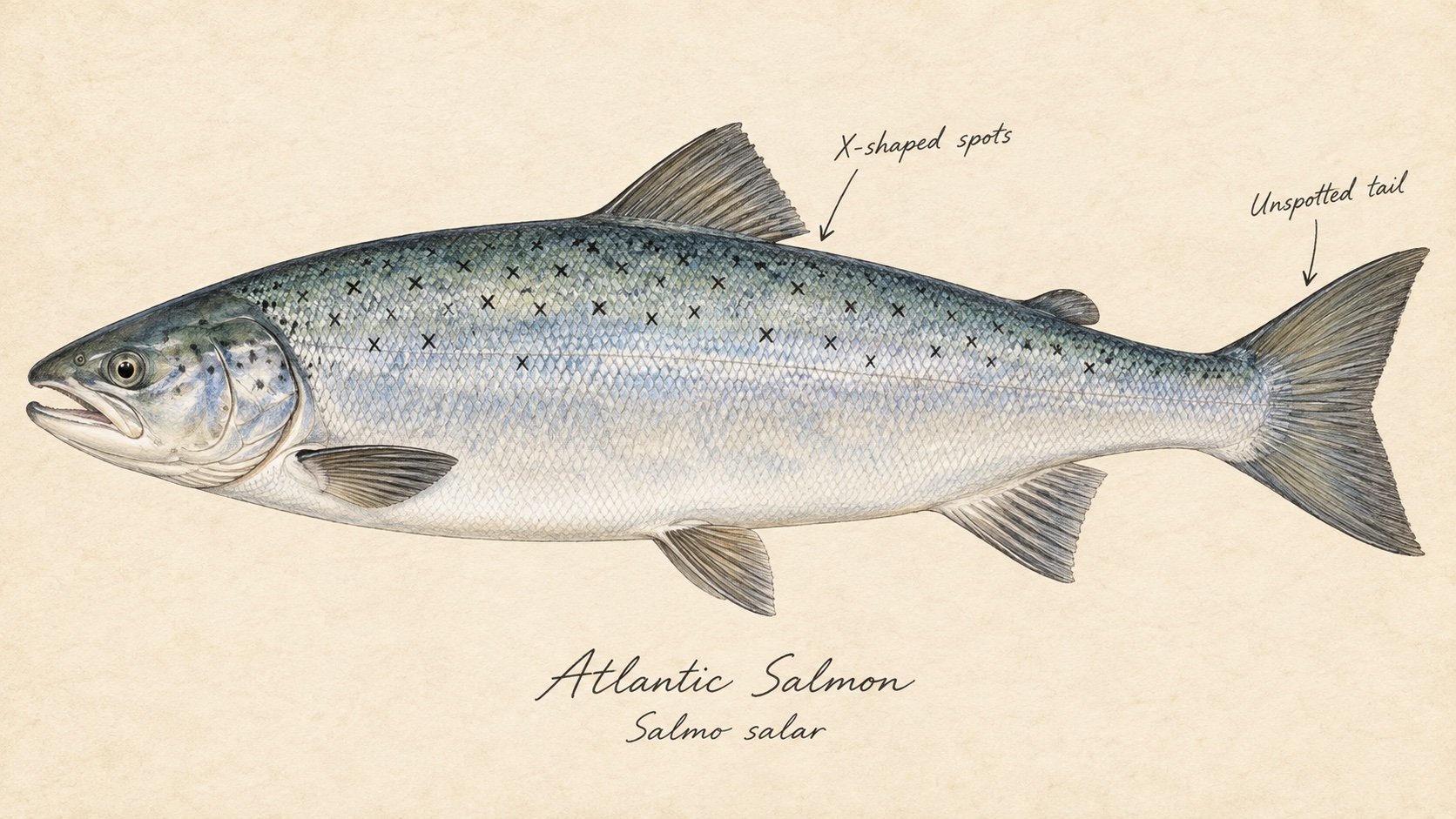
Small dark, often X-shaped body spots and a usually clear tail help distinguish an Atlantic salmon.
Atlantic salmon fishing in Australia begins with finding the right water. Tasmania's Inland Fisheries Service describes a fishery supported by adult fish released into selected lakes, alongside escapees in coastal and estuarine water. This is a different proposition from travelling to a naturally returning salmon run overseas.
Finding an opportunity
Check the recent stocking information for the lake you are considering. A historical release tells you that salmon were put there; it does not tell you how many remain or whether another release is planned. The Victorian Fisheries Authority's account of Atlantic salmon in Purrumbete and Bullen Merri describes an earlier stocking programme, so use current water information before making either a salmon destination.
Once at a stocked lake, cover the bank in stages. Explore the shallow margin first, then the drop into deeper water. A sinking fly and a repeatable countdown let you search depth without continually changing tackle.
Identification
Look for a streamlined body, a narrow wrist before the tail, scattered small dark spots and a usually unspotted, slightly forked tail. The VFA describes many of the body spots as X-shaped. Colour can become much darker in fresh water, so silver alone is not a reliable test.
Compare a doubtful fish with brown trout and Chinook salmon. Chinook commonly show spots on the tail as well as the upper body; the mouth and other features matter too. Take a moment to make the identification before deciding which rules to consult.
Food and flies
IFS lists insects, crustaceans, molluscs and small fish in the diet. For a practical starting box, carry a white streamer, an olive or black Woolly Bugger and a small nymph. IFS specifically recommends a white streamer for the Atlantic salmon fishing at Craigbourne.
A six weight is a useful starting outfit where the size of the released fish allows it; choose something stronger when the fish and conditions call for it. A floating line and an intermediate cover different depths. Fish a steady retrieve first, then vary the speed and pauses deliberately. Keep the fly moving naturally through the end of the cast instead of lifting it abruptly as it reaches the shore.
Before you go
Check the current Tasmanian Inland Fisheries Service information for the water, or Victoria's fishing guide for a Victorian destination. Confirm the applicable season, methods and possession provisions locally. Neither a release announcement nor a map record grants access to the bank.
Frequently asked questions
Are these the same fish as Australian salmon?
No. This page is about Salmo salar. The coastal fish called Australian salmon belong to a different group.
Can an old stocking record justify a trip?
Use it to identify a possible water, then look for recent releases or local information. Plan around what is happening now, rather than the date of the largest historical release.