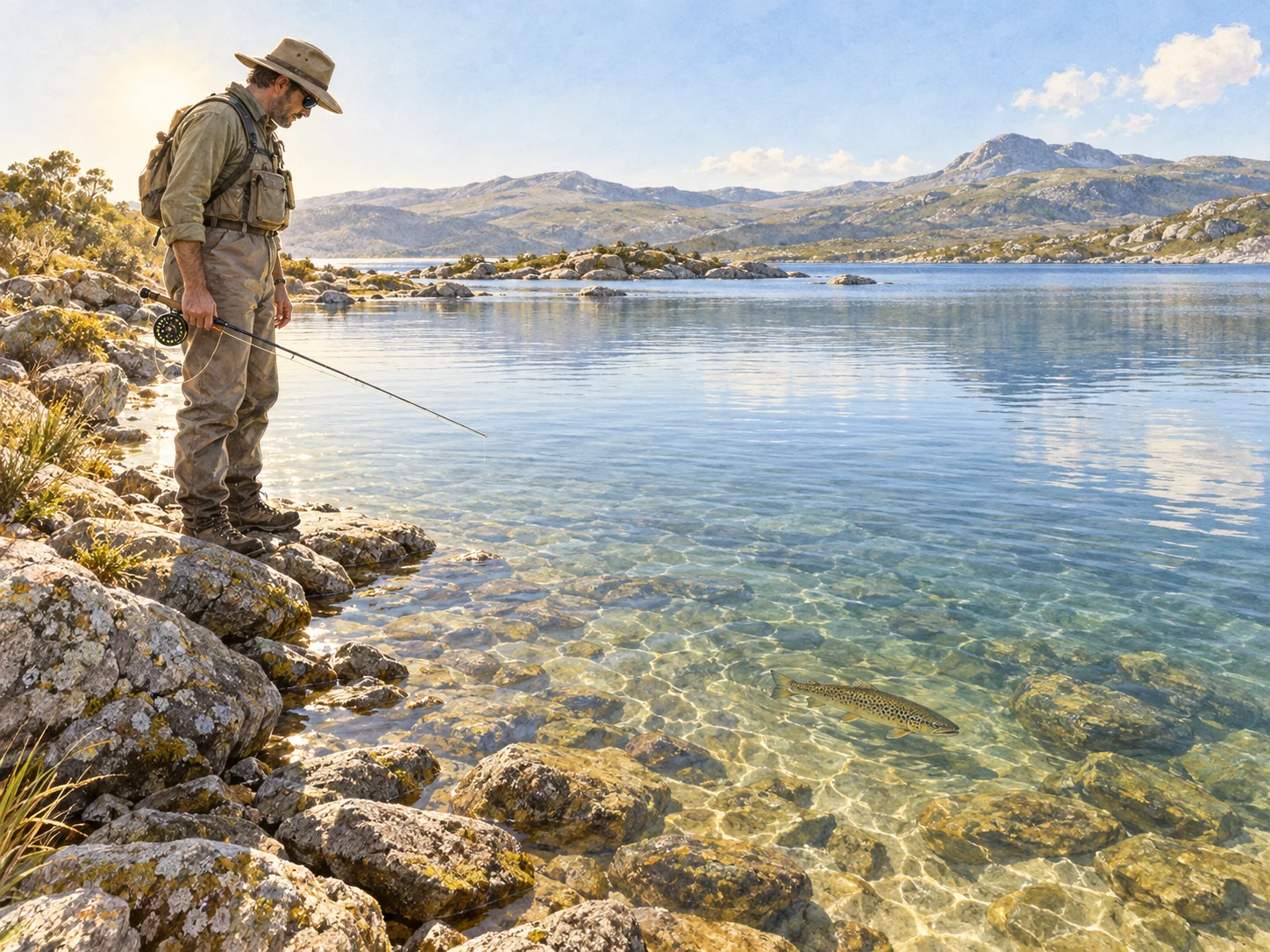
Smiths Lake is a New South Wales lake with boat ramps listed by Maritime NSW, and the reason to bring a fly rod is the mullet and garfish: fish you can often see before you cast, taken on small flies and a light line.
What divides the fishing is how you start: from a boat off one of the ramps Maritime NSW lists, or on foot where you can lawfully reach the shore. The access card names the ramps.
The first trip, and the easiest, is the boat. Launch on a calm, bright morning in the warmer months, drift the edges slowly and look for river garfish working just under the surface. A sparse baitfish fly on a four or five weight, stripped fast and high, is our pick for them. Before you go, read the current NSW recreational fishing guide for this area and the closures it lists, because that guide, not anything here, decides where and how you may fish on the day.
The second trip is on foot, for goldspot mullet, wherever signs and the current NSW guide allow it. In our experience mullet are the harder fish: they are wary, they feed on very small food, and they ignore most flies. Walk slowly with polarised glasses, find a group feeding in water where you can see the bottom, and set a tiny drab fly in front of the lead fish with as little movement as you can manage. Give it a clear, still day; wind and cloud make this trip much harder.
We would not make the drive for a big fish. Nothing on the fish list suggests one, and the pleasure here is small fish on light gear in clear water.
Check the NSW guide, pack a light rod and a box of small flies, and start at a ramp on a still morning.
Water and habitat
The fish list reads like a lake with some salt in it: goldspot mullet, river garfish and Tamar goby are, in our experience, fish of estuaries and brackish lakes rather than of fresh water.
In a lake like this, fish usually sit where the food gathers: along the edges where small fish shelter, around weed and any change from sand to darker bottom, and on the shore the wind is blowing onto. The survey-rigour chart shows how thoroughly the lake has been sampled; a light survey means there may be more fish here than the list shows.
Fish and forage
Goldspot mullet and river garfish are the fish to target. Crescent grunter is recorded less firmly, and longfin eels turn up too.
The rest of the list is the forage: Port Jackson glassfish, Pacific blue-eyes, Tamar gobies, flathead gudgeons and dwarf flathead gudgeons, with eastern gambusia along the margins. Those are small, slim fish, mostly pale or translucent, and in our experience that tells you what to tie on: sparse flies with a little flash, in size 10 to 14, rather than anything bulky.
Mullet are a different case. They mostly feed on tiny food on or near the bottom, so the fly that works for them is small, drab and fished almost still.
When to fish it
In our experience the warmer months, from spring into autumn, are the time for this kind of water. Garfish are more often up near the surface when the water is warm, and mullet are easier to spot in bright light.
Pick calm, sunny days. Clear water and a flat surface are what make sight fishing possible, and a windy grey day takes most of it away. Early morning, before the wind gets up, is a good bet.
In winter we would fish slower and deeper with a small baitfish fly, and expect fewer fish seen.
How to fish it
A four to six weight rod with a floating line covers almost everything here. Use a long, fine leader for mullet, and a slightly heavier one if you expect to hook an eel by accident.
For garfish, cast a sparse baitfish fly ahead of a group and strip it quickly just under the surface. Garfish have small, bony mouths, so keep the hook small and sharp and strike firmly but not hard. See streamer fishing for the retrieve.
For mullet, polaroid first and cast second. Put a size 14 to 16 drab fly a metre ahead of the lead fish, let it settle, and move it only a little. Be ready for many refusals; one good eat on a day is a result.
When fish sit lower, a slow sinking fly or a longer pause helps; saltwater depth control covers the options.
Access and safety
Maritime NSW lists boat ramps on the lake, and the access card names them. That is a listing of the ramps, not a statement about what you may do on the water or the land around them; read any signs on the day.
As on any lake, wear a lifejacket in a boat or kayak and check the wind before you head out. On foot, wade only where you can see the bottom. Check, clean and dry boots, waders and the boat before you move on to another water.
Regulations
No rule specific to Smiths Lake was found. Before you fish it, read the current NSW fishing rules and regulations for this area, including the list of closed and restricted waters. It sets the bag and size limits, the gear you may use and any areas where fishing is restricted, and it changes. Confirm the recreational fishing fee before you go.