How to identify Chinook Salmon
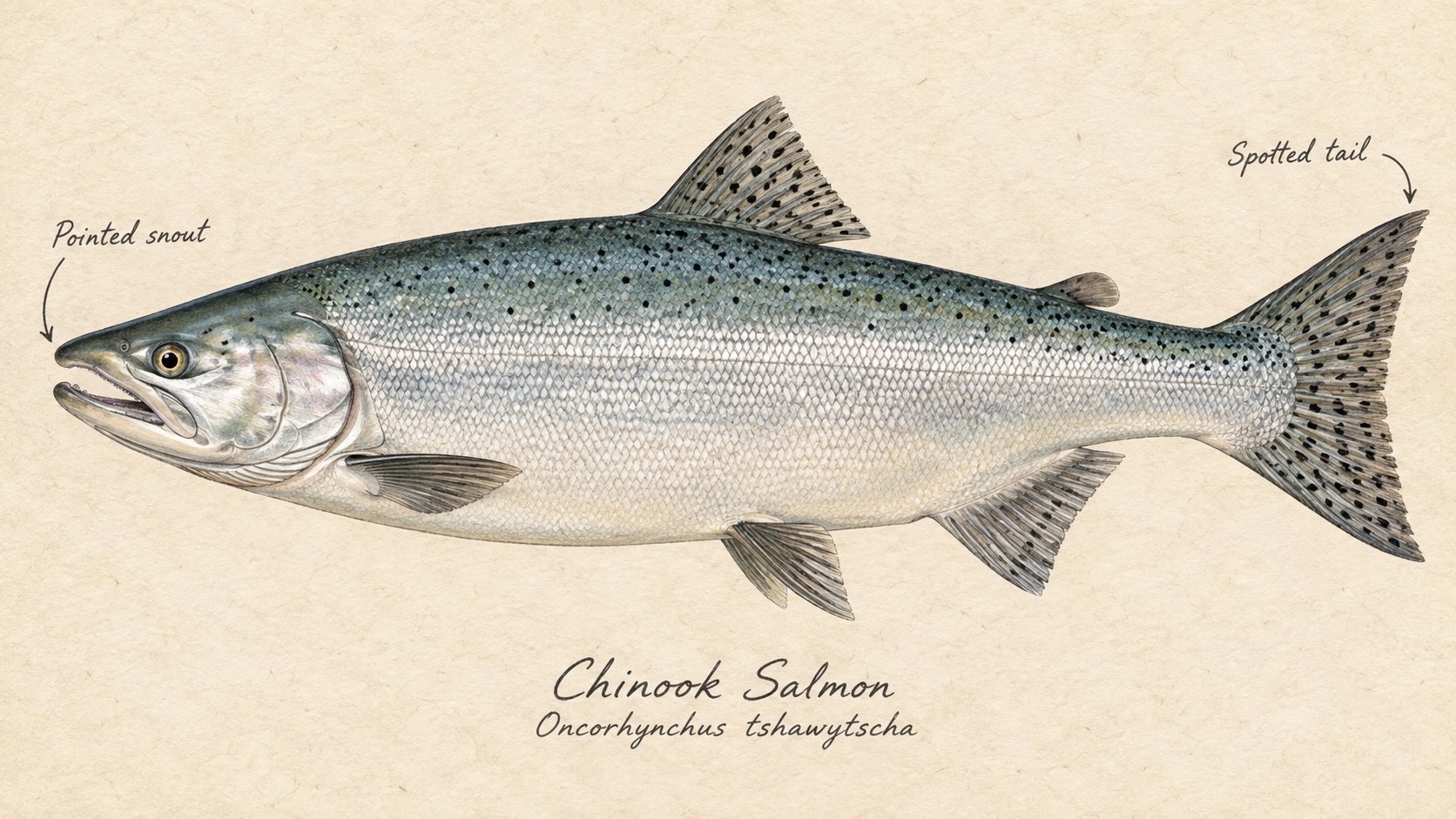
Field identification
Check the dark lining beside the lower-jaw teeth when separating Chinook from other salmonids.
A Chinook salmon gives a lake angler good reason to keep a streamer rod ready. In Australia the fishing is associated with stocked freshwater lakes, rather than the ocean-going runs of its North American home. Find the current stocking and lake information first; choosing the water is the important decision.
Australian fishery and habitat
The Victorian Fisheries Authority describes Chinook introductions to western Victorian lakes, including Purrumbete and Bullen Merri. Its species history covers several decades and changing fortunes at those lakes. Read it as background, then check the present fishery before travelling.
Deep lake water changes the way you search. Fish a reachable edge when bait or conditions put fish close to the bank, but do not assume an empty surface means an empty lake. A sinking line lets you explore the water beneath it. Keep track of the depth and retrieve that produce a follow or take.
Identification
Look for a pointed head, silver sides and small black spots on the upper body, dorsal fin and tail. The VFA identifies the dark grey-black lining beside the teeth of the lower jaw as a useful distinction from other Victorian salmonids. An Atlantic salmon generally has an unspotted tail; brown and rainbow trout need their own comparison.
Use several features together. Light, maturity and time out of the water can change the impression a fish's colour gives you.
Feeding and presentation
Chinook eat small fish, including galaxiids, as well as crustaceans, molluscs and insects. A slim baitfish streamer is a sensible first fly, with a Woolly Bugger or small crustacean pattern for a slower approach.
For general lake work, begin with a six or seven weight and a sinking option suited to the depth. Make a repeatable countdown and start with a steady retrieve. Change one element at a time: first depth, then speed, then the length of the pause. When a fish follows, continue fishing the fly rather than immediately lifting into another cast.
From a boat, set a drift that covers the edge instead of repeatedly crossing it under power. From the bank, fan the casts and work the water in front of you before moving. The purpose is to find a feeding level you can cover reliably.
Rules and recent information
Use Victoria's current recreational fishing guide and the chosen lake's current notices. Check stocking announcements separately: neither a historical maximum-size report nor an old release confirms today's fishing.
Frequently asked questions
Is Chinook another name for king salmon?
Yes, in this context. The species here is Oncorhynchus tshawytscha; common names alone can be confusing across Australian fisheries.
Should I fish deep all day?
Only when the fish give you a reason. Start with reachable feeding water and use depth systematically. A line that sinks farther than necessary can spend the whole retrieve below the opportunity.