Where it's fished
Tasmania's Inland Fisheries Service points anglers to it on the Derwent's upper reaches, fished as a wet fly right through the season. NSW DPIRD's Go Fishing guides put it to work on Snowy Mountains lakes — a size 8 to 12, fished on anything from a floating to a full sinking line, rated a strong low-light choice for both brown and rainbow trout.
Western Australia is where it comes up again and again. Recfishwest quotes one angler calling it their most productive local brown-trout fly, and for rainbows, simply "can't go past" it weighted. The Australian Trout Foundation's WA branch names it a popular choice on four separate South-West waters — the Warren River (cast across the current and drifted down), the Murray River, the Harvey and Waroona dams, and the Blackwood River.
Anatomy
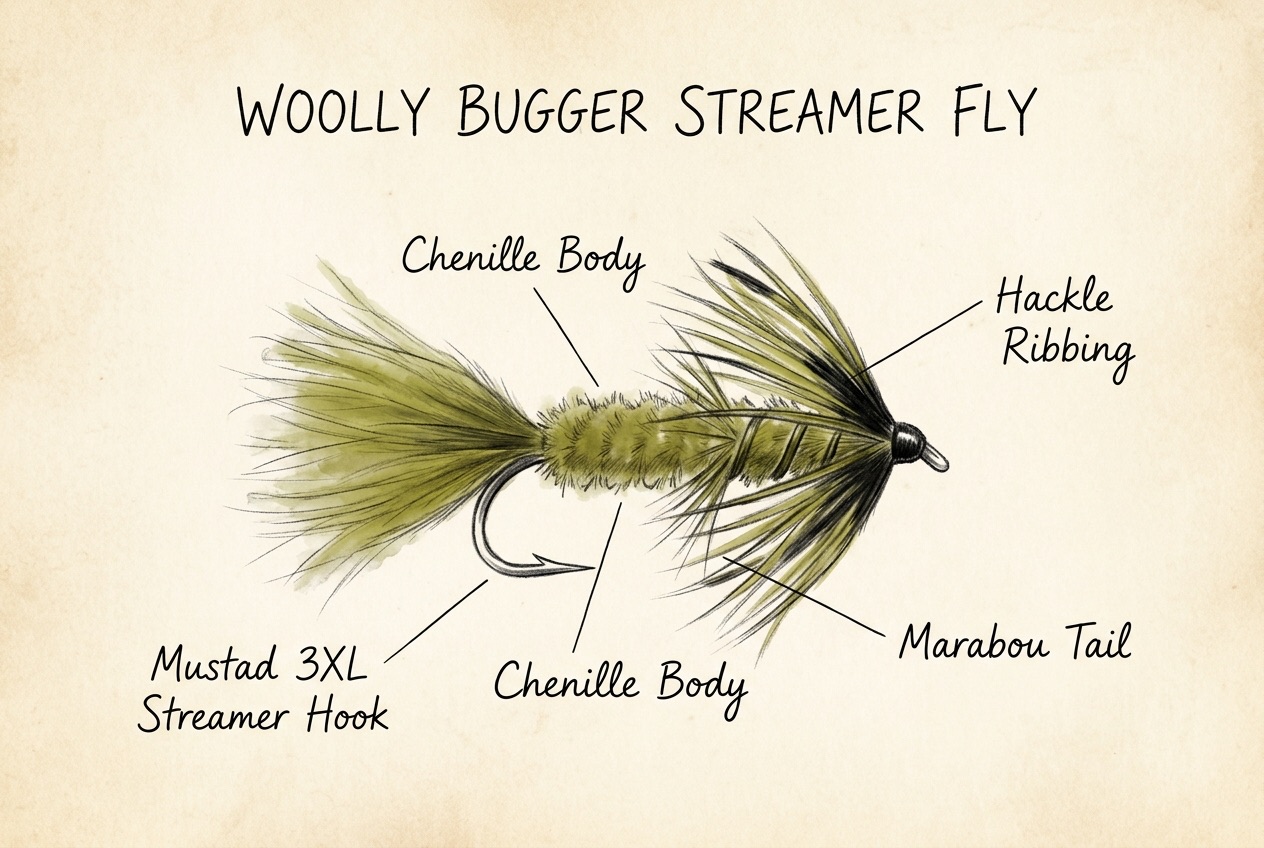
From the bend forward: a tail of marabou, as long as the shank, sometimes with a few strands of crystal flash mixed through it. A body of chenille, black, olive or brown, over a wire or lead underbody on the weighted tie. A body hackle of saddle, palmered from the tail to the head in open turns and locked down with a wire rib. A bead or a cone at the eye on the bead-head version, or a pair of dumbbell eyes on ties meant to fish upside down. A thread head.
Key features
- Marabou. The tail breathes with every pause and pulse of the retrieve, and that movement, more than any colour or shape, is what the fly sells. It looks alive when it is doing nothing.
- The palmered hackle. Legs, gills, fins, or a leech's fringe, depending on what the fish wants it to be; a pulsing halo around the body on the strip.
- It is whatever the water needs. Black in dirty water or low light, olive for a mudeye or a damsel nymph, brown for a yabby, white or grey for a baitfish. Change the colour, keep the fly.
- Weight is a decision, not a fixed thing. Unweighted for a slow swing in gentle water; beaded or coned for depth and a jigging action; dumbbell eyes to fish it deep and hook-up.
Typical materials
| Part | Typical material |
|---|---|
| Hook | 3X or 4X long streamer hook, size 6 to 12 |
| Thread | 6/0 or 140 denier, to match the body |
| Tail | Marabou blood quill, black, olive or brown, with optional crystal flash |
| Body | Medium chenille, or a dubbed body on the scruffier ties |
| Body hackle | Saddle hackle, black, grizzly or olive, palmered |
| Rib | Fine copper or gold wire, counter-wound |
| Weight | Lead-free wire underbody, a brass or tungsten bead, or dumbbell eyes |
| Head | Thread, or the bead itself |
Fishing it
Weight it or leave it bare depending on the flow — the WA advice is explicit that both have their place, heavier for faster or deeper water, unweighted for anything gentler. On a river, the standard presentation is a downstream swing: cast across the current and let it drift through, with a strip or two at the end. On stillwater, it doubles as an attractor streamer, worked on floating, intermediate or full sinking line depending on how deep the fish are sitting. Vary the retrieve until a fish tells you the speed: slow pulls with long pauses in cold water, quicker strips when the fish are chasing. The takes come on the pause as often as on the pull.