How to identify Brown Trout
Field identification
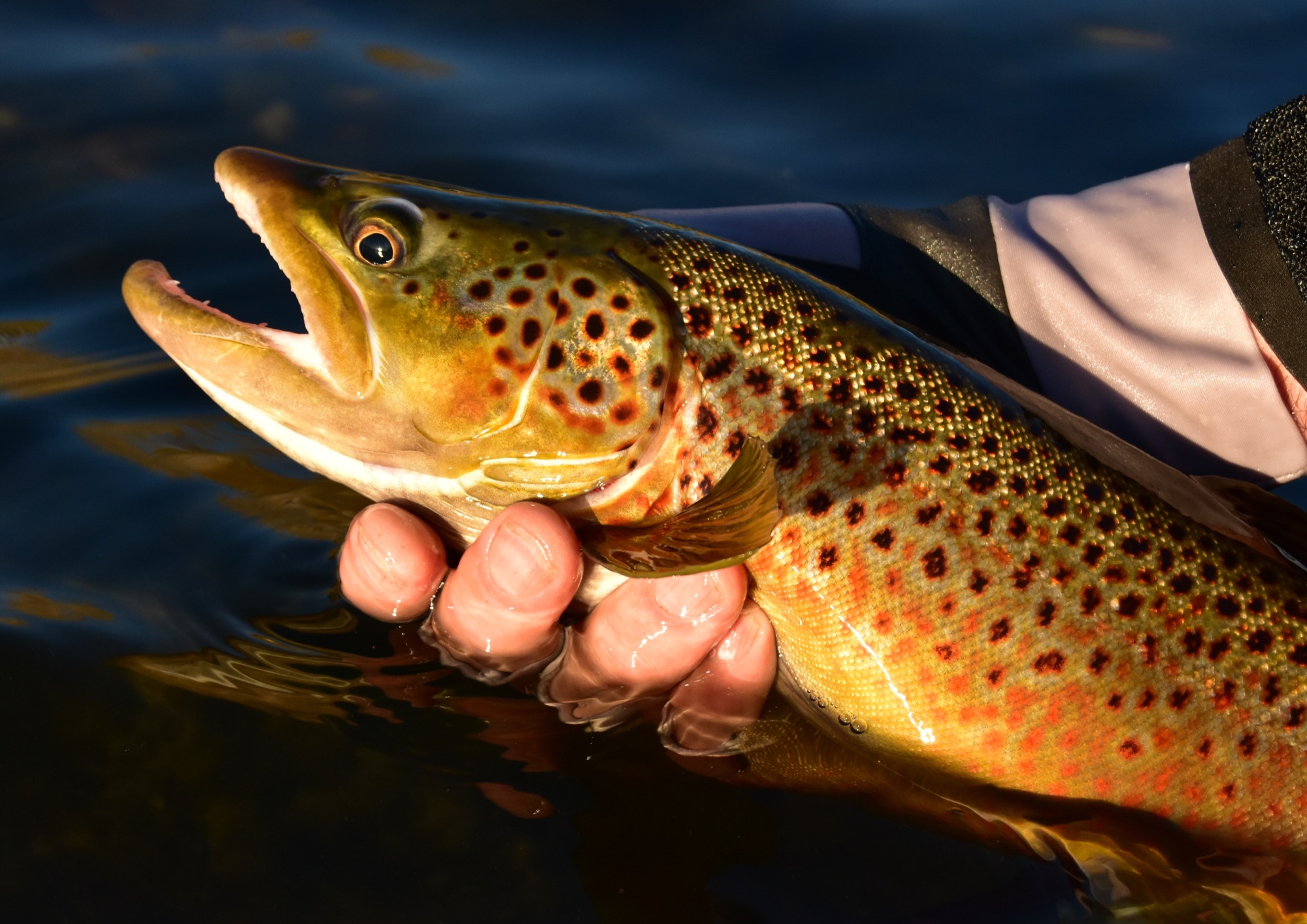
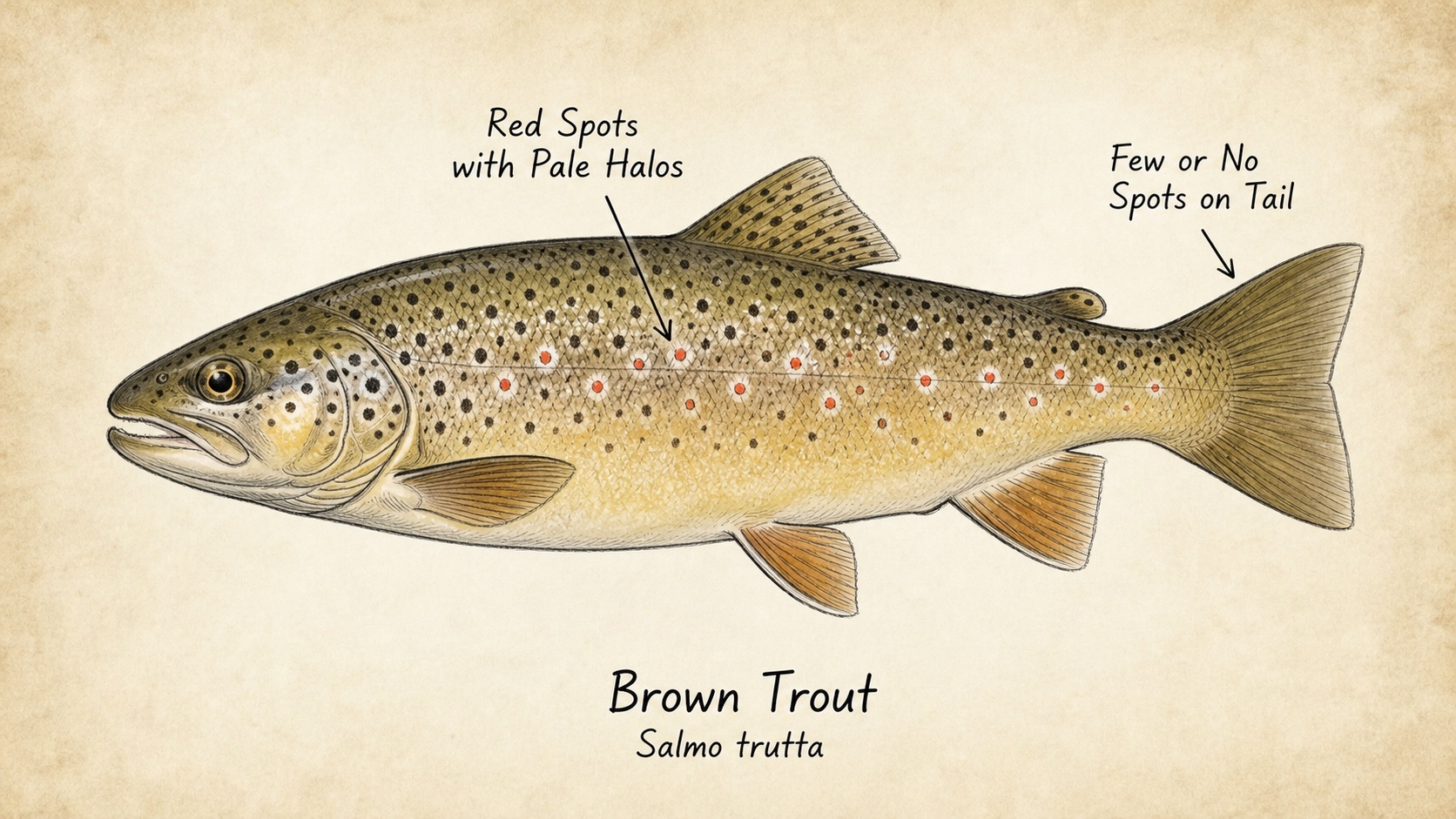
Look for a thick-bodied trout with a large head and a mouth that reaches back below the eye. The larger dark flank spots often carry a red or pale halo, with red spots more common below the mid-line. Expect few or no spots on the tail, a useful contrast with a heavily spotted Rainbow Trout tail.
The brown trout arrived in Australia in a box of eggs packed in ice and moss in 1864, survived a hundred days at sea, and has spent the century and a half since making itself the most intelligent fish in the country's cold water. It is not the biggest trout you can catch here and it is rarely the easiest; the rainbow will out-fight it and out-rise it most days. What the brown has is judgement, and that is why anglers who have caught a hundred rainbows still talk about a single brown.
Judgement is the thing to understand before you fish for one. A brown settles beside a bank or under a cut in the stream and lets the current bring food to it. It grows to know one pool the way a farmer knows a paddock. And it notices a shadow on the water, a heavy footfall, a leader landing across its window, and simply stops feeding until the disturbance goes away. Watch first, find the feeding line, and make the first cast count. Everything else about fishing for brown trout in this country is a footnote to that.
The fish plays four different games depending on where you meet it. On the Monaro's undercut tussock streams it is a wary tableland fish that gives you one cast. In the Victorian mountain rivers it is a pocket-water fish under a fallen ash, where a two-pounder is a day's reward. In the Tasmanian highland lagoons it is a single cruising fish you stalk on foot. And in the Snowy Mountains it is the autumn run, when lake fish of alarming size nose up rivers you can wade.
Start on a small river if you are learning. The Eucumbene is the small-river lesson in this guide, and the Numeralla is the tableland one. A four or five weight, a nine-foot leader, a parachute Adams for the risers and a lightly weighted nymph through the seams will cover most of it. The rest of this page covers the fish itself: how big it gets, what it eats, what water temperature does to it, and the regional guides that carry the local detail.
The quick read
Brown trout are rarely the fish to rush. In a stream they settle beside a bank, under broken current, behind a rock or beneath overhead cover and let food come to them. In a lake they can cruise a shore, work a wind lane or sit deeper until a hatch gives them a reason to move. The useful habit is the same everywhere: watch first, find the feeding line, then make the first cast count. The Eucumbene River is the small-river lesson in this guide; the Numeralla is the tableland one; the Western Lakes of Tasmania are the stalking one.
Range in Australia
An introduced cold-water fish, first established in Tasmania and now widespread through the cooler south-eastern fisheries, from the Blue Mountains gorges and the Monaro tablelands through the Snowy Mountains and the Victorian high country to Tasmania's highland lakes, with populations also established in the south-west of Western Australia. Streams, reservoirs and natural lakes all hold them where summer water stays cool enough and there is suitable gravel for spawning.
The national occurrence record is broad, but it is not a promise that every blue line still carries fish. Follow the regional guides for the smaller, practical picture; the waters, evidence and tactics change markedly from one district to another, and the water pages carry the survey and stocking record for each.
Size and what counts as a good fish
Australian brown trout have reached at least 90 centimetres and 14 kilograms, but fish below 3 kilograms make up the usual catch. Water type matters more than a single national trophy mark. A compact stream fish that owns one good pool can be a better fish for that water than a much heavier trout grown on abundant lake forage, and the lake fish that run the Snowy Mountains rivers in autumn are a different animal again from the residents they swim past.
Habitat and behaviour
Cool, well-oxygenated water is the common thread. In rivers, look for gravel, broken current, depth against the bank and nearby cover. In lakes and impoundments, clear cool margins and access to deeper water matter. Mature fish are territorial enough that a good lie can keep producing, but that does not mean the fish will sit in the fastest water. They often hold at the edge of it, on the seam where fast meets slow, where they can feed without paying the full energy cost.
Brown trout feed by sight. Insects, crustaceans, molluscs, worms and small fish are all on the menu; mayflies and caddis in the runs, grasshoppers off a tussock bank in summer, mudeyes and yabbies in the lakes. Larger fish spend more time feeding close to the bottom and are well worth approaching with a nymph, small streamer or baitfish profile when nothing is showing on top.
The mouse is a real option
Mouse fishing is real, but it is a low-percentage edge rather than an everyday Australian diet. Brown trout have been documented eating both a house mouse and a meadow jumping mouse (Cochran & Cochran, 1999). That makes a mouse imitation worth carrying for big fish after dark, especially along grassy or undercut banks when small animals are actually moving. Land it close to cover, wake it steadily, then pause it. If insects or baitfish are plainly driving the feeding, fish those instead.
Temperature changes the fish
Water temperature is one of the cleanest clues to what a brown trout is doing, and several of the gauged rivers in this guide draw their temperature record on the page. The Victorian Fisheries Authority gives 4–19 °C as the species' optimum range and, within it, 7–17 °C as the range for best food metabolism and maximum growth. It describes spawning water at about 2–12 °C during May and June in Victoria.
Brown Trout grow best between 7 and 17 °C
Published ranges, coldest to warmest — not a mortality scale.
The practical read is not “fish the number”. Through 7–17 °C, start with the normal feeding water: current seams, riffle edges, undercut banks and wind lanes. As the water climbs past 17, make colder inflows, shade, depth and an early start more important; the Numeralla gauge, sitting above 21 through summer, is what a river that has left the band looks like. In the spawning band, movement onto shallow gravel may be reproduction rather than feeding; leave paired fish and redds alone. Above 19 °C is outside the authority's published optimum, but the source does not give a universal stress or mortality cutoff, so neither does this chart.
A reliable first outfit
A four or five weight rod around eight to nine feet covers most stream fishing. Start with a nine-foot 3X leader and adjust the tippet to the water: finer and longer for flat, clear pools; shorter and stronger around timber, boulders or dirty water. On a lake, a five or six weight gives more control in wind and handles a small streamer or two-fly nymph rig without turning the cast into work.
The first fly should answer what the water is doing. A visible rise calls for a dry that matches the size and profile of the food, a parachute Adams or a Klinkhåmer for the sippers. A quiet run calls for a lightly weighted Pheasant Tail or Hare's Ear through the seam, on a dry-dropper if you want the dry in play as well. A deep pool, undercut bank or wind-darkened lake edge deserves a Woolly Bugger. Change depth before changing the whole fly box.
Spawning season
Brown trout spawn through the colder part of the year, moving onto gravel in tributaries and stream margins, and in the lake fisheries that movement is the autumn run anglers plan holidays around. The 2–12 °C band above is a Victorian reference, not a national closure calendar. The exact timing and any seasonal closure are local questions: the Eucumbene above its lake, for one, closes by law from the June long weekend and tightens its bag from the start of May while the run is on. Check the current jurisdiction rules, and treat fish gathered on shallow gravel as fish to leave alone.
Frequently asked questions
Is this a Brown Trout or a Rainbow Trout?
Colour changes with habitat, so do not make the call from “brown” versus “silver” alone. A brown trout usually carries larger dark and red flank spots with pale halos and few or no spots on the tail. A rainbow trout typically shows many small black spots across the body and a heavily spotted tail, often with a pink, red or orange band along the side. Use several marks together, especially on a silvery lake or sea-run fish.