How to identify Rainbow Trout
Field identification
If the brown trout is the fish anglers talk about, the rainbow is the fish they catch. It came to Australia from the rivers of the American Pacific coast a generation after the brown and it has the Pacific in it still: a silver-flanked, pink-banded, heavily spotted fish that will rise through two metres of lake to take a fly, chase a streamer across a drop-off, and jump when hooked in a way the brown rarely bothers to.
That willingness is the fish's defining trait, and it cuts two ways. It is why the state hatcheries have stocked rainbows by the hundred thousand into the impoundments, why the Snowy Mountains storages are rainbow fisheries as much as brown ones, and why a walk-in trophy dam like Thompsons Creek is built around them. It is also why anglers underrate them. A rainbow will forgive a poor cast that a brown would not, but it will not forgive fishing at the wrong depth.
Depth is the thing to get right. On a lake the fish are almost always deeper or shallower than you think, so find the feeding depth first, put something the right size on that line, and the rainbow will do the rest. In the rivers it holds the same pockets as the brown and eats the same dries. Match the depth before you match the hatch, and carry a Woolly Bugger.
Two kinds of trip. The lakes are where most people catch their rainbows: a windward bank in the last hour of light, a Bugger on an intermediate line along the drop-off. The rivers are the other, and some of them recruit on their own: the Eucumbene and the Mitta Mitta carry wild rainbows in their survey records, and in the Blue Mountains rainbows that have grown in Sydney's drinking-water storage run back up the Coxs gorge in winter. In spring on the Snowy Mountains creeks the lake rainbows run up in the melt to spawn.
The Rainbow Trout in the Snowy Mountains page carries the local detail. The rest of this page covers the fish: how to tell it from a brown, where it lives, a first outfit, and when it spawns.
The quick read
Rainbow trout are the fish that make a lake or a pocket of current feel busy. They will rise, chase and come up through the water in a way brown trout often will not. That does not make them easy. It makes the first honest cast more important than a box full of patterns: find the feeding depth, then put something the right size on that line. The Snowy Mountains lakes are the rainbow fishery in this guide, and the Rainbow Trout in the Snowy Mountains page carries the local detail.
Range in Australia
An introduced cold-water fish, now established through the cooler south-east and in the south-west of Western Australia. Lakes, reservoirs and high streams all hold them where summer water stays cool enough. Many of the better-known fisheries are stocking-supported, the Snowy Mountains storages and the tableland trout dams among them, and the water pages draw the stocking record where there is one. Some streams recruit on their own: the Eucumbene and the Mitta Mitta carry wild rainbows in their survey records, and the Blue Mountains gorges hold rainbows that have grown in Sydney's drinking-water storage and run back up the Coxs in winter.
A recorded occurrence is not a promise that the water in front of you is fishing. Follow the regional guides for the practical picture; lakes and rivers in the same district can fish like different species.
Habitat and behaviour
Look for cool, well-oxygenated water with a food supply. In a river that is often the seam beside faster current, the tail of a pool, and the pocket behind a rock. In a lake it is wind lanes, drop-offs, creek mouths and the depth band the fish have settled in that day.
Rainbows feed up as well as across. A nymph or small streamer worked with a lift, or a dry on a warm-evening rise, will catch fish that a dead drift along the bottom never sees. When nothing is showing, start deeper than you think and shorten the drop until you start bumping fish.
Insects, crustaceans and small fish are all on the menu: mayflies, midges and damsels on the lakes in the evening, caddis in the river riffles, mudeyes and yabbies in the storages. Match the depth before you match the hatch.
Confusing species
Colour is a poor test. A silvery lake rainbow and a pale stream brown can look closer than the names suggest. Use several marks together.
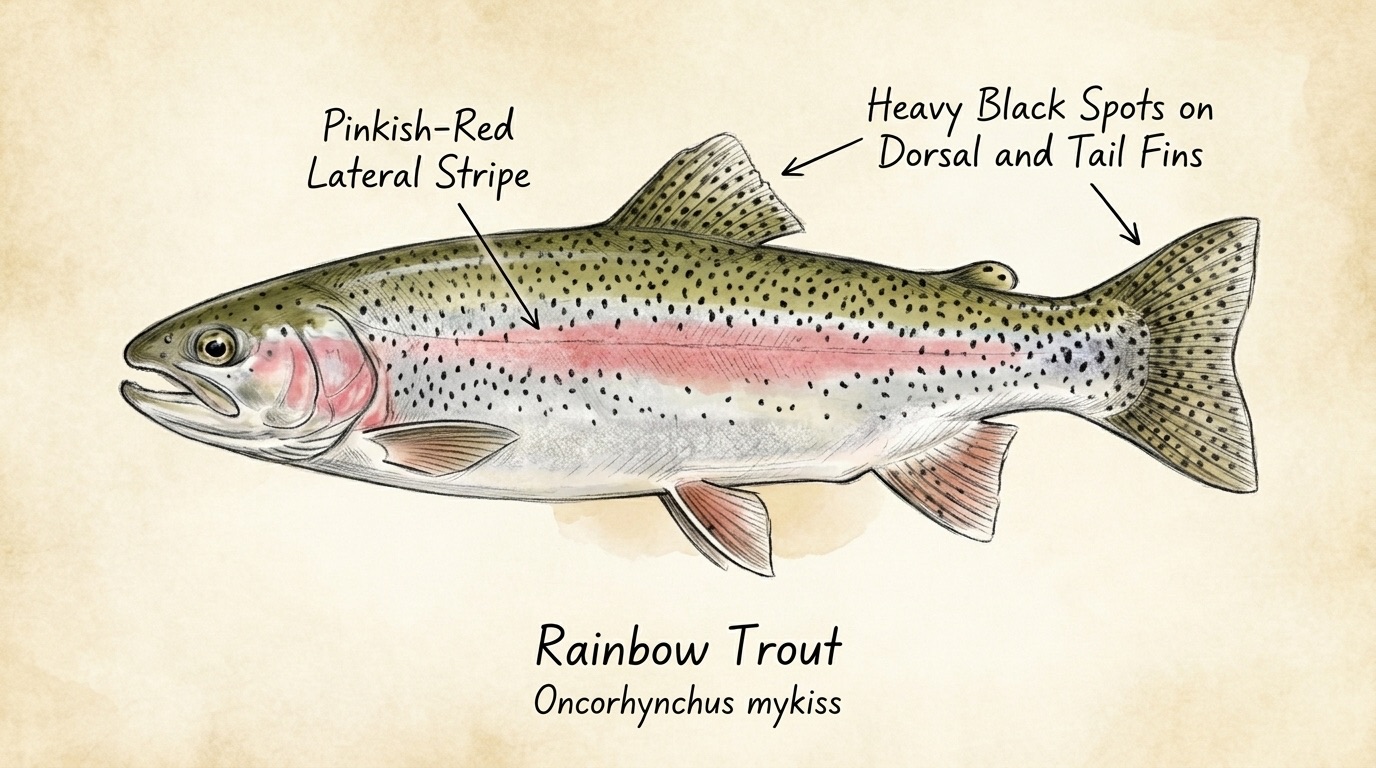
A rainbow trout typically shows many small black spots across the body and a heavily spotted tail, often with a pink, red or orange band along the side. A brown trout usually carries larger dark and red flank spots with pale halos, and few or no spots on the tail.
If you are not sure, treat the fish as the more protected lookalike until you are. The two are both legal trout in most of the waters this guide covers, but bag, size and season still depend on the jurisdiction and the water; check the current rules before you keep one.
A reliable first outfit
A four or five weight covers most streams; a five or six weight is kinder on a windy lake. Start with a floating line and a nine-foot leader, carry an intermediate for the drop-offs, and carry enough extra tippet to change diameter without rebuilding the whole rig.
The first fly should answer the water, not the box. A visible rise calls for a dry in the size of the food, and a parachute Adams is the pattern this guide keeps reaching for; NSW DPIRD's Snowy Mountains guide rates it in fourteen to sixteen for the warm-weather evening hatches. A quiet run or the water under a riffle calls for a lightly weighted Pheasant Tail or similar nymph, on a dry-dropper when the fish might look up. A lake edge, a drop-off or last light deserves a Woolly Bugger, which the same guide rates in eight to twelve as a strong low-light choice for rainbows on the lakes.
Spawning season
Rainbow trout spawn in the colder part of the year, later than browns in many Australian waters, on gravel in tributaries and lake inlets, and in the Snowy Mountains that means lake fish pushing up the feeder creeks in the spring melt as the season opens. Timing is local. Treat fish gathered on shallow gravel as fish to leave alone, and check the current jurisdiction rules for any seasonal closure before you fish a spawning stream.