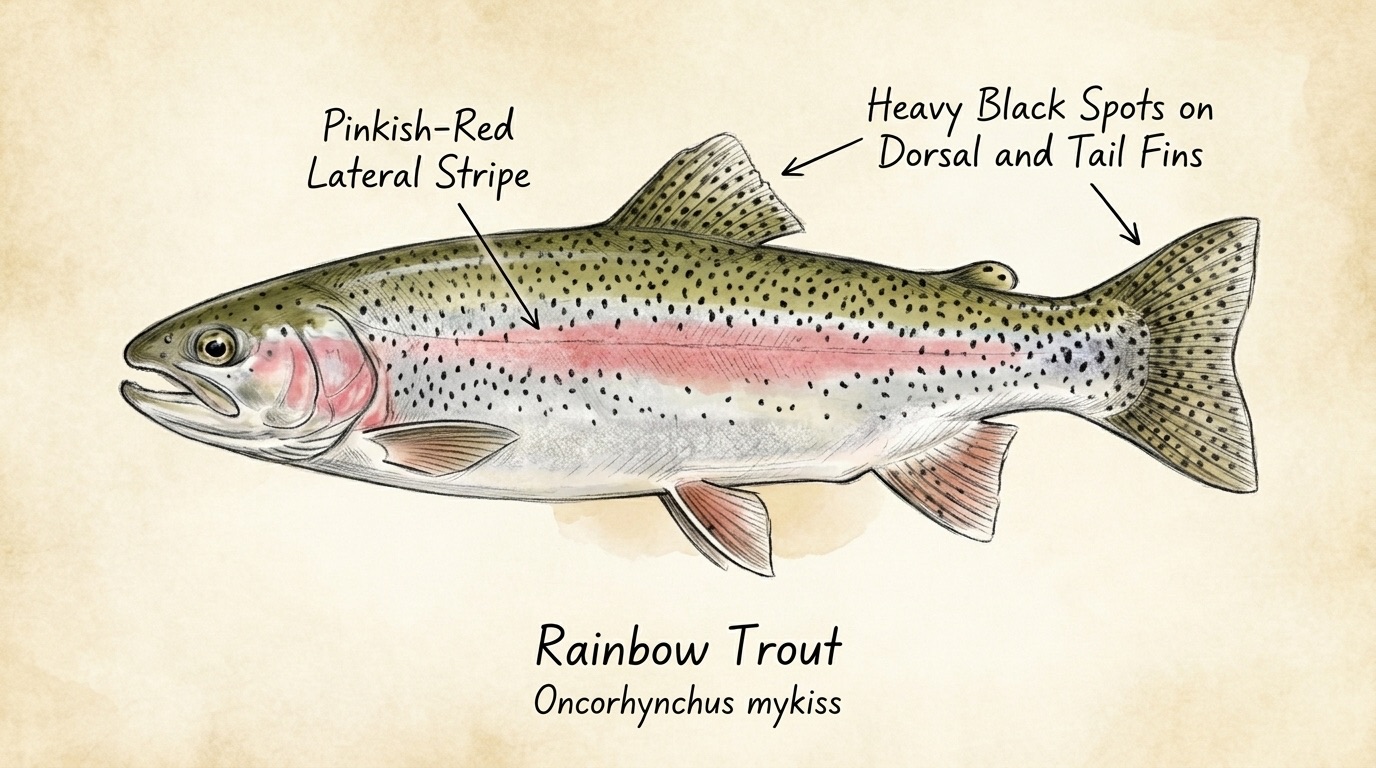
The brown trout gets the stories in the Snowy Mountains, and the rainbow gets the fishing. Stand on a windward bank of Lake Eucumbene on a still February evening as the light goes, with midges lifting off the water and the drop-off ten metres out, and the fish that comes up through the column to take a Woolly Bugger on the hang is almost always a rainbow, silver and pink-flanked and fighting twice its weight.
The rainbow here plays two tempos, and the lakes are the first. Eucumbene, Jindabyne, Tantangara and the smaller pondages are where most visiting anglers actually catch their Snowies trout, from the shore, in the last hour. Wind lanes, drop-offs and creek mouths matter more than a pretty run. Start here if you have not fished the Snowies before: walk a windward bank in the last two hours of light with a Bugger on an intermediate line, slow pulls and long pauses, and switch to a parachute Adams when fish start showing in the last of the light.
The rivers are the second tempo. In spring, as the melt eases and the season opens on the October long weekend, lake rainbows push up into the Eucumbene and the other feeder creeks to spawn, and a heavier nymph swung through the runs is the fly. Through summer the high streams inside Kosciuszko hold resident rainbows in the same pockets as the browns, taking a size fourteen dry with none of the brown's hesitation.
NSW DPIRD's own Snowy Mountains guide rates a size eight to twelve Bugger as a strong low-light choice for rainbows on the lakes and a size fourteen to sixteen Adams for the warm-weather evening hatches, and there is not much this guide would add to that. Presentation and depth lose more fish here than pattern choice.
This is not the Monaro tableland to the east, which is frost plain and undercut brown trout water. The Snowies are the range and the scheme lakes on its edge, and the rainbow is their most willing fish. The national rainbow trout page has identification and general tactics; what follows is only what changes up here.
The fishery here
The Snowies give rainbow trout two tempos. The lakes, Eucumbene, Jindabyne, Tantangara and the smaller pondages, are where most visiting anglers actually catch them: wind lanes, drop-offs, creek mouths and a fish that will come up through the column when the evening rise starts. The Eucumbene River and the high streams inside Kosciuszko are the other half, compact, cold and readable, with rainbows mixed among browns in the same pockets and a run of lake rainbows up the river in the spring water as the season opens.
This is not the Monaro. The tableland east of Cooma is open frost-plain and undercut brown trout water. The Snowies are the range and the Snowy scheme lakes on its western edge. NSW's local fishing guide folds both into one Monaro district; anglers do not. Fish the lakes when you want a rainbow session. Fish the rivers when you want to read individual lies. The national rainbow trout page has identification, general tactics and the brown trout lookalike; what follows is only what changes up here.
Where to start
Start on a lake shore if you have not fished the Snowies before. Walk a windward bank in the last two hours of light, fish a Woolly Bugger on a floating or intermediate line along the drop-off with slow pulls and long pauses, and be ready to switch to a parachute Adams when fish start showing in the last of the light. NSW DPIRD's Snowy Mountains guide rates a size eight to twelve Bugger as a strong low-light choice for rainbows on those lakes, and a size fourteen to sixteen Adams during the warm-weather evening hatches.
Choose the Eucumbene when you want to learn by reading water. Fish upstream, keep your shadow off the lie, and put the first cast on the soft edge rather than the middle of the current. Early in the season, with the lake rainbows in the river, a heavier Pheasant Tail or Hare's Ear swung through the runs is the fly; by Christmas a size fourteen to sixteen Adams and a small weighted nymph on a dry-dropper are the starting pair on the alpine creeks.
Local tackle and flies
A five or six weight earns its place on a windy lake; a four or five is enough on the rivers. Carry a floating line, an intermediate for the drop-offs, and enough 3X to 5X tippet to change without rebuilding.
The useful box is small: a Bugger in olive or black, an Adams, an Elk Hair Caddis for the evening riffles, a slim nymph or two, and a hopper for the warm afternoons along the tussock. Presentation and depth lose more fish here than pattern choice.
Timing the trip
Summer is when the lakes earn the drive: evening hatches of midges, damsels and mayflies on still days, and streamer water when the wind is up. Spring on the creeks, once the rivers open on the October long weekend, is nymph and small-dry water for the lake rainbows running up in the melt, often before the lakes have really switched on. From Christmas the creeks are dry-fly water for the resident fish, and autumn can fish either until the high streams shut down and the lakes take the trip again. Check the Snowy Mountains page and the forecast before you choose; alpine weather turns faster than the calendar.
Rules and access
NSW applies freshwater bag and size rules and separately identifies trout waters and seasonal closures, and the Eucumbene above the lake is artificial fly and lure water and a trout spawning stream with a winter close; that river's pages state the shape of the rule. Check the current NSW freshwater limits and the current freshwater closure notices before you fish. A line on the map is not access permission: use formed public access and the authority's inspected angler access sites pinned on the water pages, obey gates and signs, and do not assume a bank is public because the water is fishable.