How to identify Murray Cod
Field identification
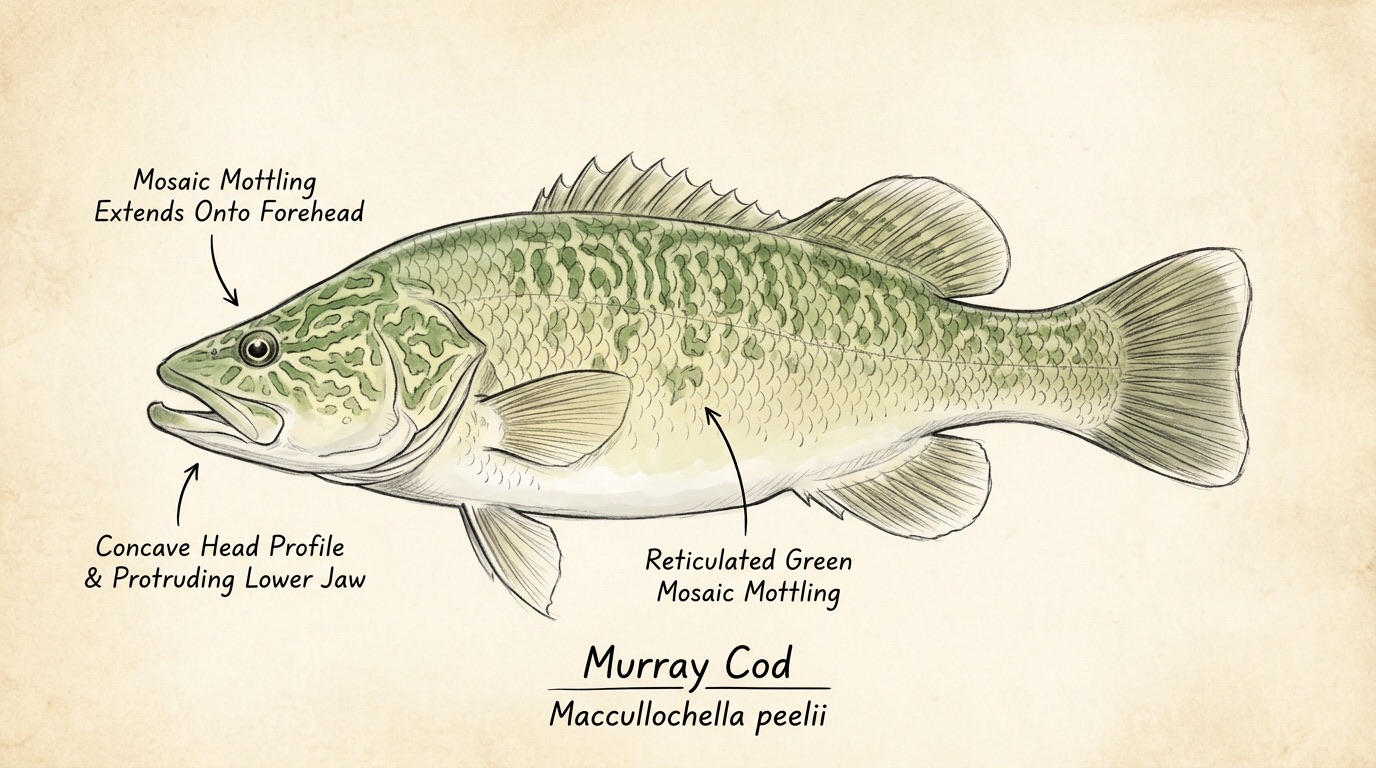
The Murray cod is the fish that made Australians fishermen, long before anyone here had heard of a trout. It is the largest fish that lives its whole life in this country's fresh water, a broad-headed, mottled-green ambush predator that can outlive the angler who catches it, and it is, since 2003, listed Vulnerable nationally. Both of those facts shape how you fish for it.
Understand how it lives first. A cod lives where it has always lived: hard against a fallen red gum in a slow brown river, under a boulder in a gorge pool, tight to a rock wall in a city lake, waiting for something to swim past that it can fit in a mouth the size of a bucket. It does not move far, because it does not need to. The fight when you hook one is not a run but a shove, straight back into the timber it came from, won or lost in the first two seconds.
Then understand why it is listed. A century of dams, desnagging and drought collapsed a fishery that once fed river towns. The stocking programs that have put hundreds of thousands of cod back into rivers like the Murrumbidgee and the Mitta Mitta and lakes like Burley Griffin have brought it back within reach of a fly, and every one of those fish deserves to go back in the water the way it came out.
The trip is structure and light. Bring a nine weight, big flies, a strip-strike you have practised, and the patience to fish a snag from every angle before you leave it. Land the fly against the timber, not near it. Fish first and last light in the warm months, and watch the gauge for the water temperature that starts the run, because the cod does not read a calendar. Cod carry a closed season in every basin jurisdiction, timed around that run, so check the current dates before you tie one on.
The rest of this page covers the range and the decline, the temperature thresholds of the spawning run, the tackle in detail, how to handle a fish for release, and the trout cod lookalike you must be able to tell apart.
Range and conservation
Endemic to the Murray-Darling Basin, and listed Vulnerable nationally since 2003; handle every fish with that in mind. The decline behind that listing was severe: commercial catch collapsed by roughly 85% within eight years through the 1950s and 60s, and even the conservative figure used for listing puts the underlying population loss at 30% or more over the preceding half-century. No single event caused it. Dams and weirs cut off the spawning migrations and flow cues fish rely on. Decades of systematic desnagging stripped rivers of the timber cod live and breed against. And the pressure has not stopped: drought and blackwater turned long stretches of the Lower Darling into a chain of shrinking, oxygen-starved pools in 2018–20, killing an estimated 1,000–6,000 cod.
In this guide, the Murrumbidgee carries a wild population and a length record from basin monitoring of more than a thousand measured fish; the Mitta Mitta and Lake Burley Griffin draw stocking timelines of hundreds of thousands of released fish. For the actual bag, size and closed-season numbers, check the current jurisdiction's fishing rules before you head out; they change by state and by water.
Spawning and temperature
Spawning is cued by temperature, not the calendar, and it does not arrive on the same week country-wide: fish in the north get moving in early spring, while further south they can hold off until late spring or early summer. The upstream and downstream spawning run typically plays out between August and January, with larval drift following behind it in spring and summer, generally late October to mid-January and peaking mid-November to mid-December.
Spawning peaks in a 1 °C window: 19–20 °C
Water-temperature thresholds for each stage of the run. Shaded ends are water the fish can't survive.
The practical read: the run is on once the water pushes past 15 °C and keeps climbing, and the best of it comes as the river holds 19–20. Watch the gauge, not the month. Murray cod carry seasonal protections across the basin jurisdictions, timed around this run; check the current dates before you tie one on.
Tackle and technique
- A 9 or 10 weight rod is the standard choice: enough backbone to cast large flies and to muscle a hooked fish away from the structure it will otherwise fight straight back into.
- Reel choice matters less than for a species that runs; Murray cod fight toward cover rather than taking long, drag-testing runs.
- Line: a floating-intermediate tropical taper or an intermediate sink tip covers most situations, enough sink to fish deeper water while still working a surface popper. A full quick-sinking line suits deep, boulder-strewn pools fished with a large articulated pattern.
- Leader: 15–25 lb, roughly 4–6 feet, scaled to how much structure is around.
- A barbless hook keeps release quick and low-handling on a Vulnerable-listed fish.
Flies: large-profile subsurface patterns and foam-head surface poppers are the standard choices, big Deceiver or Bunny-style patterns in varying weights subsurface, bigger poppers on top.
Working structure: break a snag or boulder pile into sections top to bottom and fish it methodically before moving on; do not leave good structure until every angle has been covered. On the retrieve, a fly that suspends on the pause, gives a small twitch, then resumes sinking can draw a strike from a fish holding deep against cover. Surface flies fished as far back into a snag as you think you can manage are worth pushing further still.
Land the first cast close, within a hand's width of the cover if you can manage it, rather than crashing a heavy fly straight over the fish; swim it past the target instead of dropping it on top. Vary the cadence: two or three firm strips and a pause reads differently to a holding cod than a slow hand-twist, and a fish that refuses one retrieve will often take the next. Fish every retrieve out to the rod tip. Cod will follow unseen and eat right at the boat or bank, so finish with a hang or a figure-eight rather than lifting off automatically. Strike by pulling hard with the line hand while keeping the rod tip low, not by lifting the rod trout-style; a high lift often fails to set a large hook in a hard mouth, and it does nothing to turn a hooked fish away from the cover it is about to run for.
However you hook one, keep it in the water while you unhook it, support it horizontally rather than hanging it by the jaw, and give it time to right itself and swim off under its own power before you let go. This is a Vulnerable-listed fish, and how you handle it in the last thirty seconds matters as much as how you caught it.
Confusing species
The trout cod is the lookalike, and the one you must be able to tell apart: it is a threatened native in its own right. This guide holds no reviewed field marks for the pair yet. If you are not sure which cod you are holding, treat it as a trout cod, keep it in the water, and let it go.