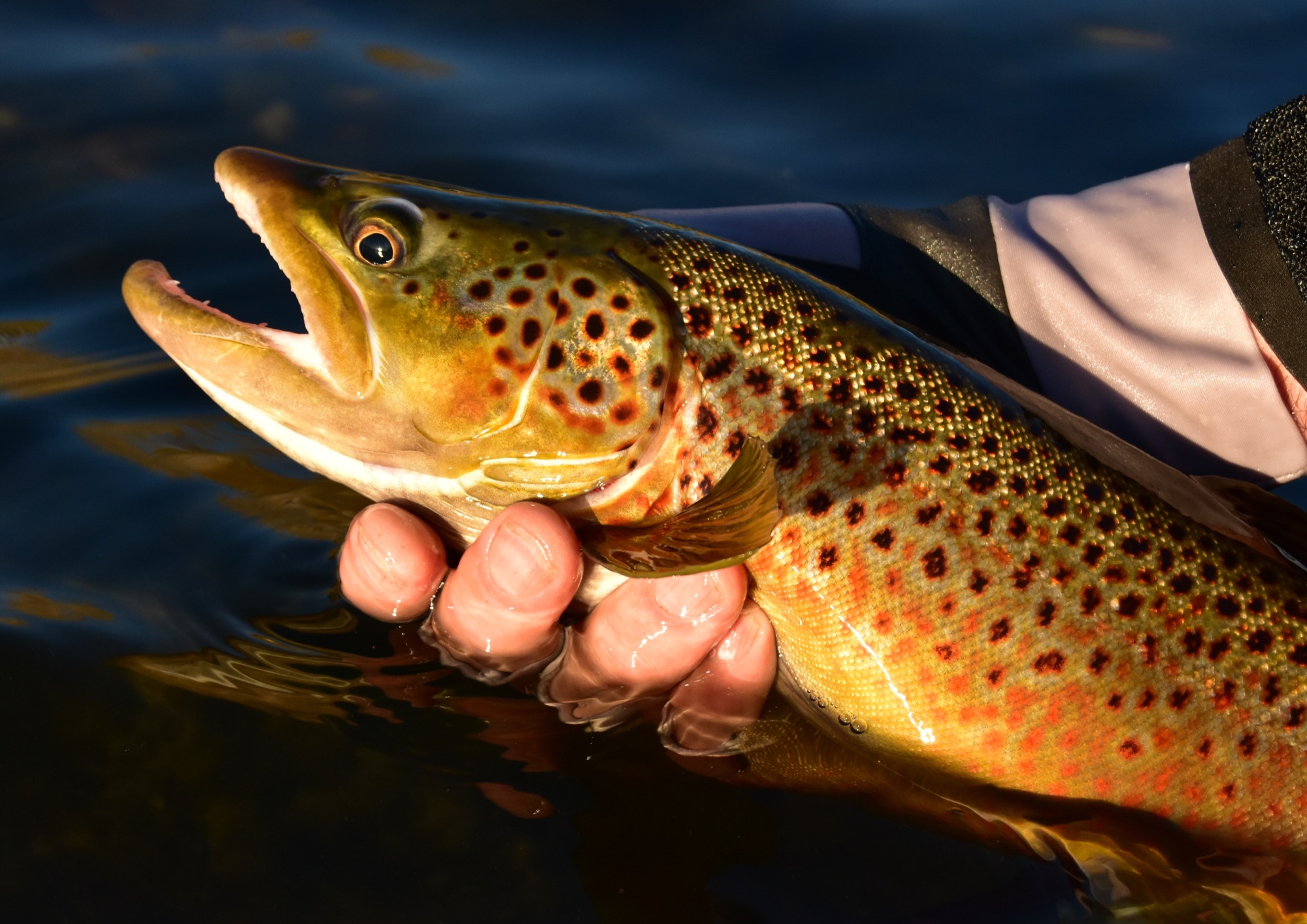
A brown trout on the Monaro lives several lives, and the angler who wants to understand the region has to meet it in each of them. The same species, three different games, all within an hour of each other, which is why this country rewards more than a day trip.
The first is the tableland fish: a pound or two of wariness under an undercut bank on a stream so clear you can see the gravel it holds over, a fish that has watched the paddock all week and will give you one cast. The second is the pocket-water fish of the high streams inside Kosciuszko, small, quick and wild, taking a size fourteen dry without hesitation because nothing much comes down that gorge that it can afford to refuse. The third is the lake fish the Snowy Mountains are famous for, grown for years in Eucumbene or Jindabyne on mudeyes and yabbies to a size you do not associate with a river you can wade, and turning up that river every April on business of its own.
Each has a water to learn it on. The Eucumbene River is the small-river lesson, one lie at a time, with resident fish through summer and the lake browns on top of them in autumn. The Snowy River is where you cover water for the bigger fish with a nymph. The Numeralla is the tableland lesson, and its gauge will tell you it is an autumn and spring one, not a summer one.
Start on the Eucumbene if you are new to the region. Fish upstream, keep the sun out of your shadow, and spend the first cast on the soft edge beside the main current rather than dropping it into the middle. A dry-dropper lets the fish choose, and from Christmas a hopper tight to the tussock bank is the afternoon fly. The rules on the Eucumbene above the lake are the tightest on any trout stream in the state, and that river's pages state their shape. Check the current NSW closure notices before you drive.
The fishery here
The Monaro gives brown trout room to live several different lives. The Eucumbene River is the small-river lesson: clear seams, undercut banks, pocket water in the gorge below Kiandra and long glides at Denison, resident fish through the summer and the lake browns on top of them in autumn, with seventy years of gauge record drawn on the page so you can see which weeks the river is usually in order. The Snowy River is larger, more open and more variable, with the kind of long runs and deep holding water that reward covering ground. The Numeralla River east of Cooma is the treeless tableland stream, slow, clear, warm in summer, and its browns are the wariest in the region.
Around them sit colder tributaries and pondages where the captured observation record confirms brown trout at different points in time. Some are promising names on a map, not finished access guides. Treat the linked water pages as the honest starting points and the remaining list as evidence to research before a trip.
Where to start
Start on the Eucumbene if you want to learn by reading individual lies. Fish upstream, keep the sun out of your shadow, and spend the first cast on the soft edge beside the main current rather than dropping it into the middle. A dry-dropper, a buoyant dry with a small tungsten nymph below it, lets the fish choose without forcing you to fish every pocket twice, and from Christmas a hopper tight to the tussock bank is the afternoon fly.
Choose the Snowy when you want to cover more water with a nymph or a small streamer. Work the heads and tails of pools, the inside edge of bends and any current break that offers depth close to food. If the river is pushing hard after a release, the useful water often shrinks to the edges.
Choose the Numeralla in April or October, not January, and fish it from your knees.
Local tackle and flies
A four or five weight is enough for the tributaries; a five or six weight earns its place on a windy day or on the larger river. Carry a floating line, a nine-foot leader stretching to twelve on the glassy tableland pools, and enough 3X to 5X tippet to adjust without rebuilding the whole rig.
The useful box is compact: a parachute Adams and a Klinkhammer for the mayfly and the sippers, an Elk Hair Caddis for the evening riffles, a hopper for warm afternoons, bead-head Pheasant Tails and Hare's Ears in a few weights, and a slim dark or olive Woolly Bugger for the lake fish and the coloured water. Match the depth and speed before chasing an exact pattern. In clear Monaro water, presentation loses more fish than fly choice.
Timing the trip
Spring brings rising water and improving insect activity, but on the high rivers it also brings the melt, cold and coloured into November, and the rivers above Lake Eucumbene are closed by law until the October long weekend. Summer, from Christmas, opens the dry-fly window on the alpine streams and makes shade, altitude and water temperature the deciding factors: the tableland streams warm into the twenties and the trip moves west. Autumn produces deliberate, well-conditioned fish everywhere, and then the run, the big lake browns pushing up the Eucumbene and the other feeder rivers through April and May until the rivers close after the June long weekend. Winter turns the focus to the open impoundments. Conditions move faster than a seasonal label here, so check the water page and the forecast before choosing between a small tributary and the main river.
Rules and access
NSW applies freshwater bag and size rules and separately identifies trout waters and seasonal closures, and the rules on the Eucumbene above the lake are the tightest on any trout stream in the state; that river's pages state their shape. Check the current NSW freshwater limits and the current freshwater closure notices before you fish. A line on the map is not access permission: use formed public access and the authority's inspected angler access sites pinned on the water pages, obey gates and signs, and do not assume a bank is public because the water is fishable.
Observation record by water
Ingeegoodbee River
2 records · 2024 · recent
2 records · 1993 · historic
Kybeyan River
1 record · 2007 · historic
Swampy Plain River
1 record · 2014 · historic
6 occurrence records in the captured observation snapshot. Bars compare records, not fish abundance; methods and survey effort differ by water.
Recorded stocking
89,225 fish across 99 stocking records
- Mowamba River · 500 · 2020 · annual site total
- Mowamba River · 500 · 2021 · annual site total
- Mowamba River · 500 · 2022 · annual site total
- Mowamba River · 500 · 2023 · annual site total
- Mowamba River · 500 · 2024 · annual site total
- Mowamba River · 600 · 2025 · annual site total
- Mowamba River · 750 · 2026 · annual site total
- Mowamba River · 1,000 · 2020 · annual site total
- Mowamba River · 750 · 2021 · annual site total
- Mowamba River · 1,000 · 2022 · annual site total
- Mowamba River · 1,000 · 2023 · annual site total
- Mowamba River · 500 · 2024 · annual site total
- Mowamba River · 1,000 · 2026 · annual site total
- Mowamba River · 1,000 · 2020 · annual site total
- Mowamba River · 750 · 2021 · annual site total
- Mowamba River · 1,000 · 2022 · annual site total
- Mowamba River · 1,000 · 2023 · annual site total
- Mowamba River · 125 · 2024 · annual site total
- Mowamba River · 750 · 2026 · annual site total
- Mowamba River · 1,000 · 2020 · annual site total
- Mowamba River · 1,000 · 2021 · annual site total
- Mowamba River · 1,000 · 2022 · annual site total
- Mowamba River · 1,000 · 2023 · annual site total
- Mowamba River · 250 · 2024 · annual site total
- Mowamba River · 800 · 2025 · annual site total
- Mowamba River · 1,000 · 2026 · annual site total
- Mowamba River · 1,000 · 2020 · annual site total
- Mowamba River · 750 · 2021 · annual site total
- Mowamba River · 750 · 2022 · annual site total
- Mowamba River · 750 · 2023 · annual site total
- Mowamba River · 250 · 2024 · annual site total
- Mowamba River · 500 · 2026 · annual site total
- Mowamba River · 1,000 · 2020 · annual site total
- Mowamba River · 750 · 2021 · annual site total
- Mowamba River · 1,000 · 2022 · annual site total
- Mowamba River · 1,000 · 2023 · annual site total
- Mowamba River · 250 · 2024 · annual site total
- Mowamba River · 1,250 · 2026 · annual site total
- Maclaughlin River · 1,000 · 2021 · annual site total
- Maclaughlin River · 1,000 · 2022 · annual site total
- Maclaughlin River · 1,000 · 2023 · annual site total
- Maclaughlin River · 1,000 · 2024 · annual site total
- Maclaughlin River · 800 · 2025 · annual site total
- Maclaughlin River · 1,000 · 2026 · annual site total
- Maclaughlin River · 1,000 · 2021 · annual site total
- Maclaughlin River · 1,000 · 2022 · annual site total
- Maclaughlin River · 1,000 · 2023 · annual site total
- Maclaughlin River · 1,000 · 2024 · annual site total
- Maclaughlin River · 800 · 2025 · annual site total
- Maclaughlin River · 1,000 · 2026 · annual site total
- Maclaughlin River · 1,000 · 2021 · annual site total
- Maclaughlin River · 1,000 · 2022 · annual site total
- Maclaughlin River · 1,000 · 2023 · annual site total
- Maclaughlin River · 1,000 · 2024 · annual site total
- Maclaughlin River · 800 · 2025 · annual site total
- Maclaughlin River · 1,000 · 2026 · annual site total
- Maclaughlin River · 1,000 · 2021 · annual site total
- Maclaughlin River · 1,000 · 2022 · annual site total
- Maclaughlin River · 1,000 · 2023 · annual site total
- Maclaughlin River · 1,000 · 2024 · annual site total
- Maclaughlin River · 800 · 2025 · annual site total
- Maclaughlin River · 1,000 · 2026 · annual site total
- Maclaughlin River · 2,000 · 2020 · annual site total
- Maclaughlin River · 2,400 · 2021 · annual site total
- Maclaughlin River · 2,400 · 2022 · annual site total
- Maclaughlin River · 2,400 · 2023 · annual site total
- Maclaughlin River · 1,200 · 2020 · annual site total
- Maclaughlin River · 400 · 2021 · annual site total
- Maclaughlin River · 900 · 2022 · annual site total
- Maclaughlin River · 400 · 2023 · annual site total
- Maclaughlin River · 400 · 2024 · annual site total
- Maclaughlin River · 400 · 2021 · annual site total
- Maclaughlin River · 400 · 2022 · annual site total
- Maclaughlin River · 400 · 2023 · annual site total
- Maclaughlin River · 500 · 2020 · annual site total
- Maclaughlin River · 400 · 2021 · annual site total
- Maclaughlin River · 250 · 2022 · annual site total
- Maclaughlin River · 250 · 2023 · annual site total
- Maclaughlin River · 250 · 2024 · annual site total
- Maclaughlin River · 300 · 2025 · annual site total
- Maclaughlin River · 250 · 2026 · annual site total
- Maclaughlin River · 500 · 2020 · annual site total
- Maclaughlin River · 400 · 2021 · annual site total
- Maclaughlin River · 250 · 2022 · annual site total
- Maclaughlin River · 125 · 2026 · annual site total
- Maclaughlin River · 500 · 2020 · annual site total
- Maclaughlin River · 400 · 2021 · annual site total
- Maclaughlin River · 250 · 2022 · annual site total
- Maclaughlin River · 125 · 2026 · annual site total
- Maclaughlin River · 300 · 2025 · annual site total
- Maclaughlin River · 250 · 2026 · annual site total
- Coolumbooka River · 1,000 · 2020 · annual site total
- Khancoban Creek · 2,500 · 2020 · annual site total
- Khancoban Creek · 2,500 · 2021 · annual site total
- Khancoban Creek · 2,500 · 2022 · annual site total
- Khancoban Creek · 2,500 · 2023 · annual site total
- Khancoban Creek · 2,500 · 2024 · annual site total
- Khancoban Creek · 2,000 · 2025 · annual site total
- Khancoban Creek · 2,500 · 2026 · annual site total
An annual site total may combine several physical releases. Stocking records do not establish survival, present abundance or catchability.